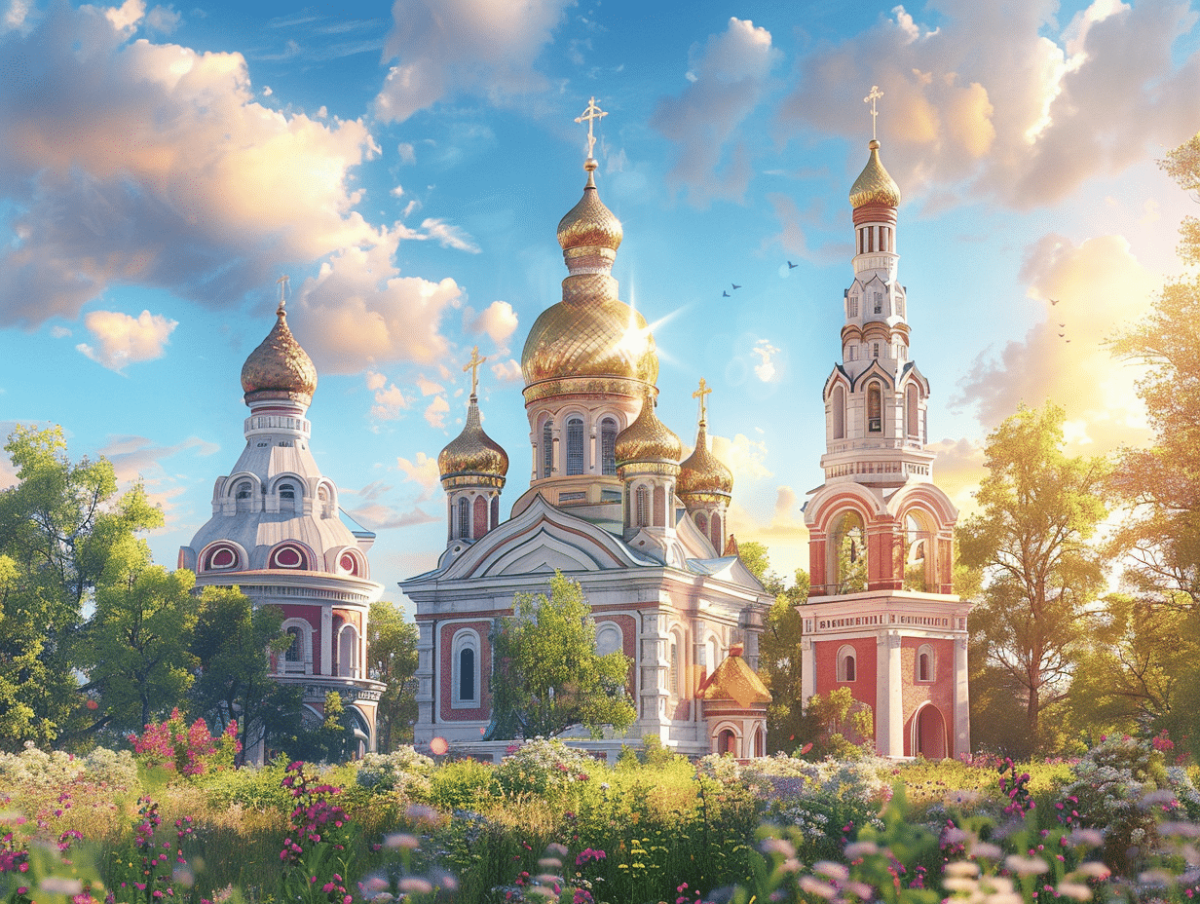
Christianity, with over two millennia of history, is rich in diversity and complexity. The main branches of this faith, namely Catholicism, Protestantism, and Orthodoxy, share fundamental beliefs while diverging on doctrinal, liturgical, and organizational points. Understanding these differences requires immersing oneself in the history of Christianity, from the early councils to the reforms that reshaped the religious landscape.
The Theological and Historical Foundations of Divergences
The schism of 1054, a historical event of major discord, marks the separation between the Roman Catholic Church and the Orthodox Church. The roots of the conflict delve into deep theological differences, particularly regarding the question of the Holy Spirit and its procession. For the Catholic Church, it proceeds from the Father and the Son, while for the Orthodox Church, it proceeds exclusively from the Father. This doctrinal divergence, far from being anecdotal, reflects differing conceptions of the Trinity and ecclesiastical organization.
In terms of ecclesiastical authority, the question of papal infallibility, proclaimed at the First Vatican Council, deepens the divide between Catholics and Orthodox. This doctrine, which grants the Pope, Patriarch of Rome, an error-free authority in matters of faith and morals, is rejected by the Orthodox Church. For them, the Patriarch of Constantinople is considered a primus inter pares, first among equals, without enjoying supreme authority over all autocephalous Churches.
Relations between the two confessions have also been marred by painful historical events, such as the sack of Constantinople in 1204, during the Fourth Crusade, which left deep scars and contributed to worsening relations between Eastern and Western Christians. These historical events have helped forge distinct and sometimes antagonistic ecclesial identities.
When developing a comparative chart of Catholic, Protestant, and Orthodox beliefs, be sure to take these fundamental elements into account. The belief in purgatory, present among Catholics but absent among Orthodox, or the place given to the Virgin Mary and Joseph in worship and theology, vary substantially from one confession to another. These differences are not merely remnants of ancient disputes but living manifestations of distinct theological traditions that still structure the identity of each confession today.
Distinctive Liturgical and Structural Practices
At the heart of liturgical practices, the Eucharist stands as a central sacrament for both the Catholic Church and the Orthodox Church, but the way of conceiving the real presence of Christ varies. The doctrine of transubstantiation among Catholics, which asserts that the bread and wine literally become the body and blood of Christ, differs from the Orthodox approach which, while affirming this presence, leaves the mystery of its realization unexplored, emphasizing the epiclesis, the invocation of the Holy Spirit to consecrate the gifts.
The autocephalous Orthodox Churches, independent in their governance but united in faith, contrast with the centralized hierarchical structure of the Catholic Church, led by the Pope. This decentralized organization of the Orthodox Churches reflects an ecclesiology where local autonomy is articulated with universal communion, without a single supreme authority.
The difference is also evident in the area of the sacraments of ordination, baptism, and confirmation. While the Catholic Church typically administers these sacraments at distinct moments in a believer’s life, the Orthodox Church tends to administer them together during the same ceremony for newly baptized individuals, emphasizing the unity of the sacraments of Christian initiation.
The divergence in the use of liturgical calendars, with the Orthodox Church largely adhering to the Julian calendar and the Catholic Church having adopted the Gregorian calendar, leads to Easter celebrations and feast days occurring on different dates. This temporal distinction, far from being a mere matter of astronomical calculations, reflects the particularities that continue to shape the identity of each confession across time.