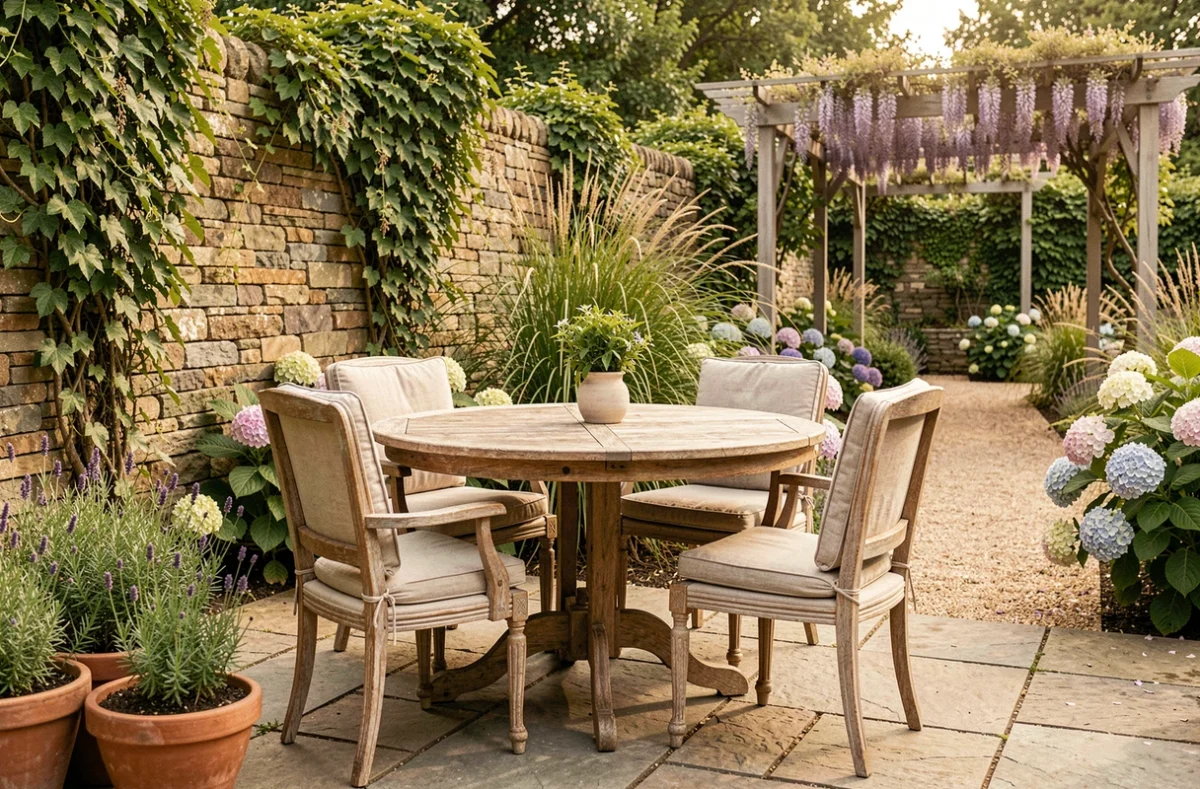
A garden that is only used three months a year is an underutilized garden. The challenge is not to multiply equipment, but to choose plants, materials, and lighting that make the outdoor space usable from the first frost to the summer heatwaves. Designing a welcoming garden year-round requires thinking in terms of seasons, not decorative trends.
Water-efficient plants and staggered blooms for a garden alive twelve months
You may have noticed that a spectacular flowerbed in June can look like a wasteland in November? The problem often stems from a plant selection focused on a single blooming period.
The solution lies in one principle: stagger blooms across four seasons. A male dogwood blooms as early as February, a lilac takes over in spring, lavenders cover the summer, and a mahonia scents the late autumn. This succession creates a garden that changes its appearance every month without ever looking bare.
Prefectural drought orders may prohibit watering ornamental beds during certain time slots, or even almost entirely in crisis situations. Relying on water-efficient plants is therefore not only ecological, but also a safeguard against restrictions. Resources like dededanssonjardin.com help identify varieties suited to these climatic constraints.
Mulching reduces watering and protects roots from frost. A layer of wood chips or hemp, renewed twice a year, retains moisture in summer and insulates the soil in winter. It is the most cost-effective action for sustainable landscaping.

Diverse hedge: privacy, windbreak, and biodiversity in one design
Most competitors talk about privacy screens or fences. The real lever for a welcoming garden year-round is a hedge composed of several species, much more effective than a uniform screen of thuja.
Why mix species in a hedge
A diverse hedge offers staggered blooms, filters the wind instead of creating turbulence (unlike a solid wall), and provides resources for garden helpers: berries for birds in winter, nectar for pollinators in spring.
- Deciduous species (hornbeam, hazel): they let in winter light when it’s most needed while providing a dense screen in summer
- Evergreen species (eleagnus, photinia): they ensure permanent privacy and visually structure the space even under snow
- Berry-producing species (elderberry, blackthorn): they nourish local wildlife and bring intense autumn colors
Alternating deciduous and evergreen prevents the hedge from visually dying in winter. The idea is to place evergreens at strategic points (facing neighbors, on the side of the prevailing wind) and deciduous where light matters more.
This hedge also plays a role as a natural windbreak. A garden exposed to cold wind becomes unusable as early as October. With a hedge that filters gusts, the terrace remains pleasant much later in the season.
Nocturnal outdoor lighting: user comfort and respect for wildlife
A welcoming garden in the evening requires thoughtful lighting, not a string of lights placed randomly. The French decree of December 27, 2018, regulates the lighting of parks and gardens accessible to the public and stipulates that for certain installations, lights must be turned off by 1 a.m. at the latest.
At home, the same principles should be applied to protect nocturnal migratory birds, bats, and pollinating insects.
Practical rules for useful lighting without nuisances
Direct each light fixture towards the ground, never towards the sky. A recessed light in a stair tread illuminates the passage without dazzling or scattering light. Low bollards along a path produce the same effect.
Favor warm light. Cool color temperatures attract more insects and disrupt nocturnal biological cycles.
- Motion detectors in passage areas: lighting only turns on when someone walks through, reducing consumption and light pollution
- Timer on the ambient lighting of the terrace: it automatically turns off after a chosen delay
- Low voltage fixtures with protected transformer: treat outdoor lighting as an electrical safety issue, not just decoration, to avoid accidents related to moisture and frost
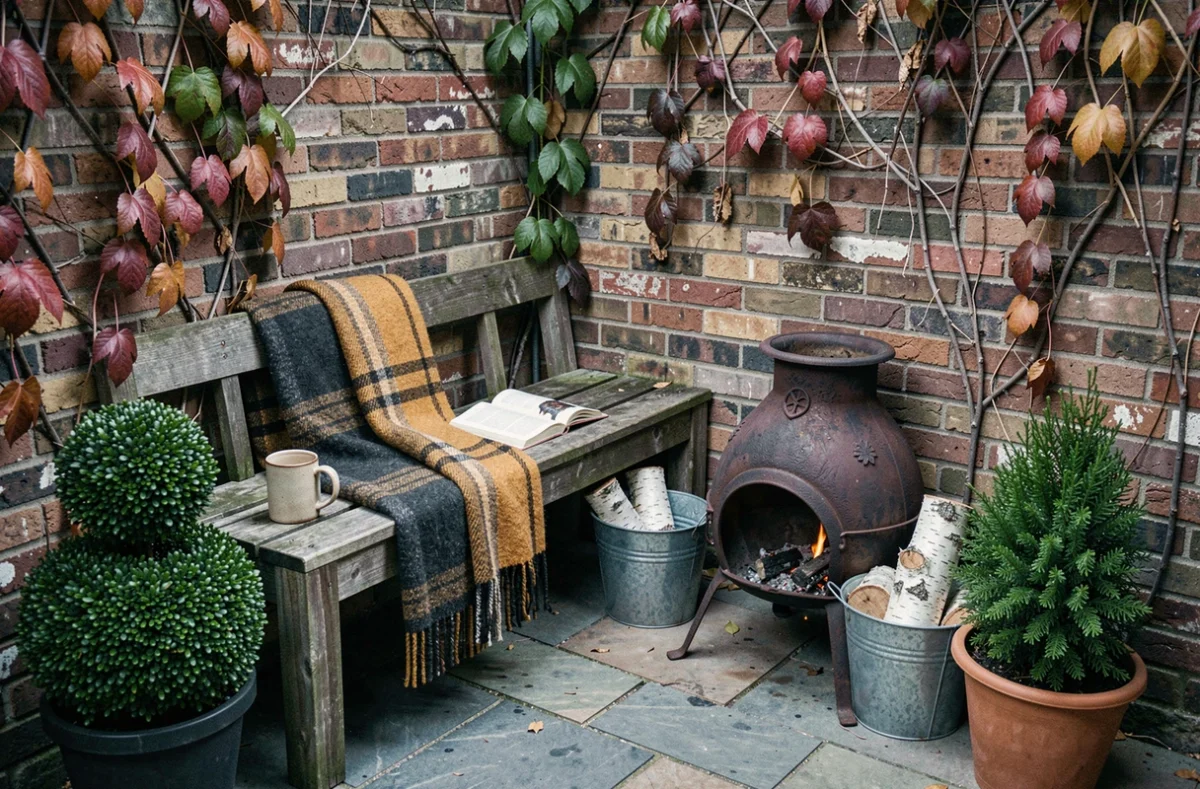
Terrace and dining area: materials that withstand all four seasons
An outdoor dining space used year-round has different requirements than a summer lounge. The choice of flooring and furniture determines the durability of the setup.
Wood remains the most pleasant material to the touch, even barefoot in summer. Class 4 species (black locust, chestnut) resist permanent moisture without chemical treatment. A local class 4 wooden deck lasts several decades without heavy maintenance.
For furniture, treated steel or aluminum withstand freeze-thaw cycles without warping. Synthetic rattan is less affected by moisture than natural rattan, but it ages poorly under intense UV. A solid compromise: metal structures with removable cushions, stored in winter.
Orientation and protection of the dining area
Place the dining area to the south or southwest to capture winter sun when every ray counts. A pergola with adjustable slats protects from rain in autumn and creates shade in the height of summer. This dual use justifies the investment compared to a simple parasol, which is only useful for four months.
If your land is windy, the diverse hedge described above provides much better protection than a screen. Combining a hedge on the windward side and a pergola above creates a sheltered area usable from March to November in most French regions.
A welcoming garden year-round relies on three structural choices: water-efficient plants with staggered blooms, a mixed hedge that protects as much as it beautifies, and subtle lighting directed towards the ground. The rest, furniture and decoration, can adapt. These foundations determine whether the outdoor space will thrive for twelve months or only during the nice days.