The performance gaps between two thermal augers that look similar can sometimes reach 30% on hard soils. Engine displacement does not always guarantee better efficiency, contrary to what commercial signage suggests. Some popular models show higher failure rates after just the third intensive use.
Some brands fail to specify the mechanical tolerances on the technical sheet, even though this information directly influences durability in difficult conditions. Therefore, the choice is not limited to a question of power or price, but is based on a series of criteria that manufacturers rarely detail.
Understanding the different types of thermal augers and their uses in the garden
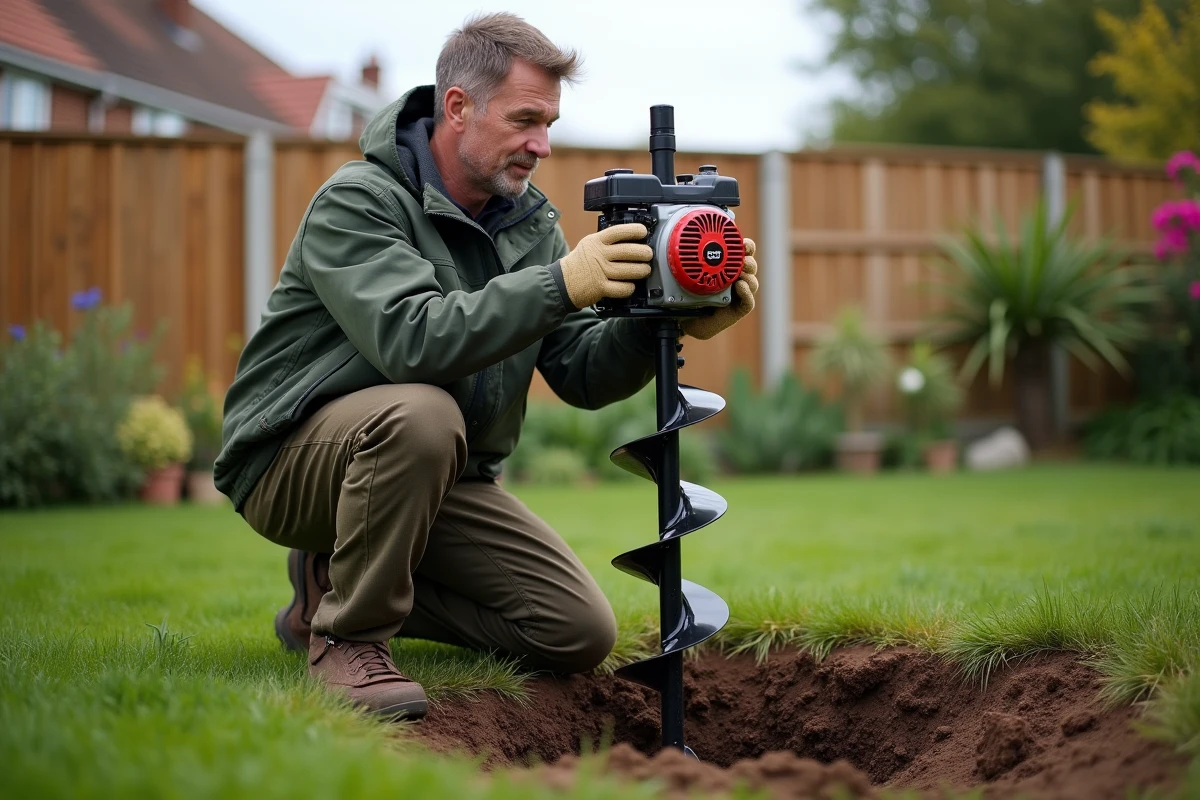
It is impossible to discuss the choice of an auger without taking the time to understand the specifics of each family of tools. This diversity shapes how we will tackle the soil, whether it is loose, clayey, or filled with stones. The thermal auger is the choice for anyone who wants a fast, autonomous tool capable of handling tough terrain. It is found on all job sites where speed is essential: fence installation, intensive planting, small foundation work.
In contrast, the manual auger still has a place for small interventions or soils that are easy to work with. Less noise, no engine to maintain, but the price to pay is effort. The electric model appeals to occasional gardeners who want to limit technical constraints, provided they do not expect to drill through the most compact soils. As for the hydraulic auger, it falls into another category, reserved for heavy-duty projects or the planting of large trees, usually with the support of a dedicated machine.
To find your way, you must start by looking at the terrain to be treated and the nature of the holes to be made. Before making a decision, ask yourself the right questions: depth, diameter, soil composition. The quality of the bit, its diameter, length, and robustness will make all the difference in practice. The resources offered by tariere-thermique.com, particularly their comparative file, help clarify things and go beyond commercial arguments. This choice impacts your efficiency, safety, and the ability of your tool to last without failing during gardening tasks.
What criteria should you prioritize when choosing a thermal auger suited to your needs?
Simply relying on the power listed on the technical sheet would be a mistake. Several factors should guide the selection of a thermal auger that is truly suited to the terrain and the workload anticipated. The engine, expressed in cm³ or kW, must be sized to tackle hard, stony, or clayey soils without flinching. For repeated plantings or fence installations in difficult soil, a solid motorization is essential.
The bit, then, plays a central role. Its diameter (generally from 80 to 300 mm) and length (often between 60 and 80 cm, sometimes more with an extension) must match the size of the holes to be drilled. A robust material like alloy steel or carbon steel ensures good wear resistance. Finally, for frequent or professional use, certain features change the game: automatic disengagement system for safety, anti-vibration handle to relieve the user and limit fatigue.
Here are the points to examine closely when making your choice:
- Power and displacement: adapt them to the nature of the soil and the depth of the work.
- Bit: choose the right diameter and length, in a durable material.
- Machine weight: a model that is too heavy complicates the task, especially on difficult or sloped terrain.
- Safety systems: automatic disengagement, anti-vibration handle, emergency stop.
- Accessories: extensions, interchangeable bits, self-locking systems to expand possibilities.
- Maintenance: ease of access to parts for cleaning (bit, air filter, etc.).
Particular attention must be paid to safety. Gloves, protective glasses, and reinforced shoes are never superfluous. Taking these elements into account means gaining efficiency on the ground and preserving the tool over time.
Comparison and reviews of the most efficient models on the market in 2024
Given the abundance of models, it is worth focusing on the characteristics that make a difference. The best-designed thermal augers come with a robust engine, often between 52 and 80 cm³, capable of handling the most demanding soils. A tank of at least one liter allows for continuous operation without wasting time refueling, which is important on large job sites or during mass plantings.
The quality of the bit quickly separates entry-level models from high-end references. Treated carbon steel guarantees wear resistance, even during repeated uses. In terms of safety, some manufacturers now integrate automatic disengagement or an anti-vibration handle, details that ensure comfort and control. Modular extension systems and compatibility with several bit diameters (from 80 to 300 mm) broaden the range of accessible uses, from simple planting holes to deeper and more technical drilling.
A trend is emerging in the French market: the search for compact machines weighing less than 10 kg that combine maneuverability and power. Experienced users appreciate this versatility without sacrificing comfort during long sessions. Another criterion is maintenance. The most advanced models facilitate cleaning the bit and accessing filters to limit wear and prolong the tool’s lifespan. Ultimately, a thermal auger must meet a triple imperative: versatility, robustness, ergonomics. A trio that makes a difference from the first turns, especially when the ground resists or the job site stretches on.