A sustainable house is primarily defined by its carbon footprint over its entire life cycle, from the extraction of materials to demolition. Since the implementation of RE2020, every new construction must comply with a carbon emissions ceiling (construction Ic indicator) that becomes stricter in phases. The 2025-2027 phase, which is stricter than the previous one, requires rethinking the choice of materials well beyond their simple “natural” label.
Life Cycle Analysis: The True Criterion for an Ecological Material
Competitors readily list wood, straw, or hemp as ecological materials. This catalog approach masks a crucial technical point: it is the life cycle analysis that classifies a material, not its plant or mineral origin.
The LCA measures greenhouse gas emissions, water consumption, and gray energy from production to end of life. Wood imported by cargo from another continent, chemically treated and then difficult to recycle, can have a heavier carbon footprint than locally produced low-carbon concrete. Environmental and health declaration sheets (FDES) allow for comparing these impacts product by product.
The portal Eco Construction brings together technical resources on the biosourced material sectors and their actual environmental performances, a useful complement to cross-reference FDES data with site feedback.
Specifically, three families of materials deserve particular attention for sustainable construction:
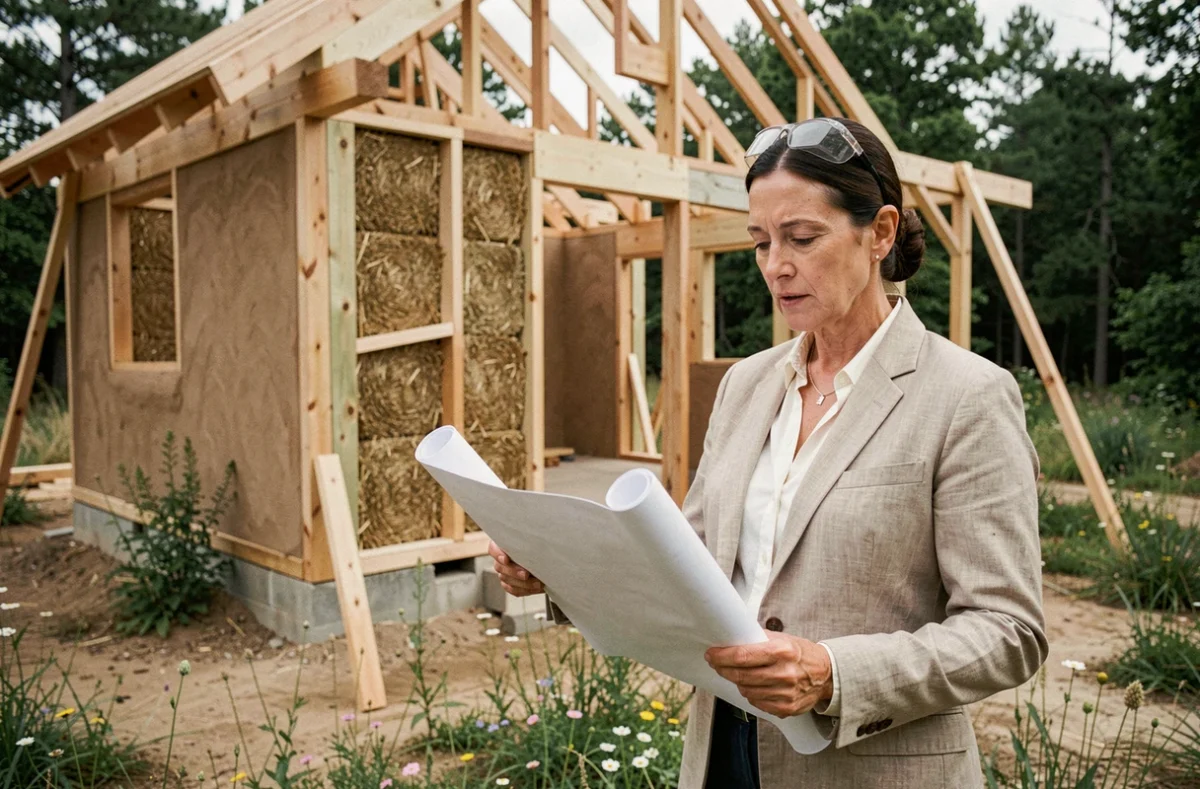
- Biosourced insulators (wood fiber, cellulose wadding, hemp) that store carbon throughout the building’s life and offer good thermal lag in summer.
- Low-carbon concretes reformulated with alternative binders to Portland cement, whose Ic construction score significantly decreases compared to conventional concrete.
- Wood structures from sustainably managed forests (PEFC or FSC certification), provided that the supply chain remains short to limit transport.
Summer Overheating and Summer Comfort: The Blind Spot of the Ecological House
Many ecological construction projects focus on winter insulation performance. However, RE2020 introduced a summer comfort indicator, the degree-hours of discomfort (DH), which measures occupants’ exposure to excessive indoor temperatures.
A highly insulated but poorly designed house can become an oven in summer. Effective insulation retains accumulated heat if no measures are taken to expel it. The Ministry of Ecological Transition acknowledges that the calculation tools for this indicator are still evolving, making vigilance even more necessary from the design stage.
Natural Ventilation and Thermal Inertia
Cross ventilation remains the most efficient solution for cooling a dwelling. It requires thoughtful orientation of openings, with windows positioned on opposite facades to create a draft.
The thermal inertia of materials plays a complementary role. A rammed earth wall, compressed earth brick, or hemp concrete accumulates nighttime coolness and releases it during the day. This thermal lag, measured in hours, determines the delay between the external heat peak and the internal temperature peak.
Fixed solar protections (overhangs, sunshades, green pergolas) complement the system by blocking direct radiation on south and west-facing windows.
Renewable Energy and Sobriety: Prioritizing Choices
Installing photovoltaic panels on a poorly insulated house is like heating outside with green electricity. Energy sobriety starts with reducing needs before producing.
Prioritizing Insulation and Air Tightness
The insulation aspect conditions all others. A high-performance envelope (walls, roof, ground floor) combined with careful air tightness drastically reduces heating needs. The airtightness test, mandatory at the end of construction for individual houses under RE2020, verifies that air leakage remains below the regulatory threshold.
Energy Production Adapted to the Site
Once needs are reduced, the choice of production system depends on the local context. Solar thermal panels cover a significant portion of hot water needs. Self-consumed photovoltaics reduce electricity bills and improve the overall energy balance of the building.
The air-water heat pump remains the most common heating system in new constructions compliant with RE2020. Its performance coefficient allows for producing several units of heat for one unit of electricity consumed, but its sizing must precisely match the calculated losses of the building.
RE2020: Anticipating Upcoming Carbon Phases
The environmental regulation RE2020 does not set a single and definitive threshold. It operates through progressive phases. The carbon threshold applicable to individual houses has tightened since 2025, and new reductions are planned for 2028 and then by 2031.
This trajectory has a concrete consequence on construction choices: a project designed today at the strict regulatory minimum risks becoming obsolete in a few years, both in terms of heritage value and actual performance.
Choosing materials with an Ic construction score below the next threshold protects the investment in the long term. Since September 2026, the Ministry of the City and Housing has made public the actual performance data of RE2020 constructions, allowing for comparisons of the results of buildings that have actually been realized, not just design promises.
The sustainable house is not a catalog of green solutions stacked on top of each other. It is a technical arbitration between a high-performance envelope, low-carbon impact materials verified by LCA, management of summer comfort, and energy production sized to real needs. The now accessible field data allow these arbitrations to be based on facts, not on marketing labels.